Geospatial data science · Transportation geography

Mapping how places
shape opportunity.

I study transportation, accessibility, and urban systems through spatial data—building practical evidence for communities and decision-makers.

Transportation GISAccessibilityGeoAISpatial equityUrban systems

Past work

Spatial evidence for more accessible places.

Across transportation, child care, employment, food access, and environmental resilience, my work turns complex spatial patterns into questions that planners can act on.

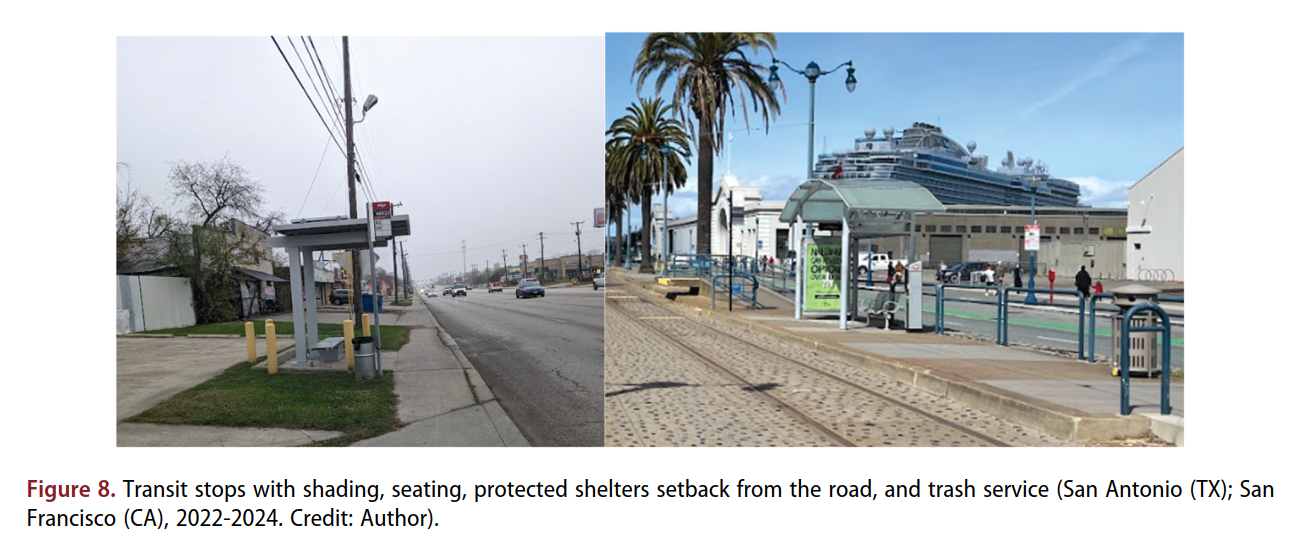
Contrasting public transit stops with different levels of shelter, seating, and separation from traffic
2025Transit accessibility

Evaluating public transportation through a caregivers’ lens

Topic
How transit policies, infrastructure, and station environments support—or burden—caregivers traveling with young children.
Method
Comparative assessment of 14 U.S. transit systems using route observations, a structured accessibility audit, air-quality measurements, and transit-director interviews.
Implication
Stroller access, elevators, safe waiting areas, restrooms, water, and weather protection should be treated as core transit infrastructure. Designing for caregivers also improves mobility for older adults and disabled riders.
Read the paper
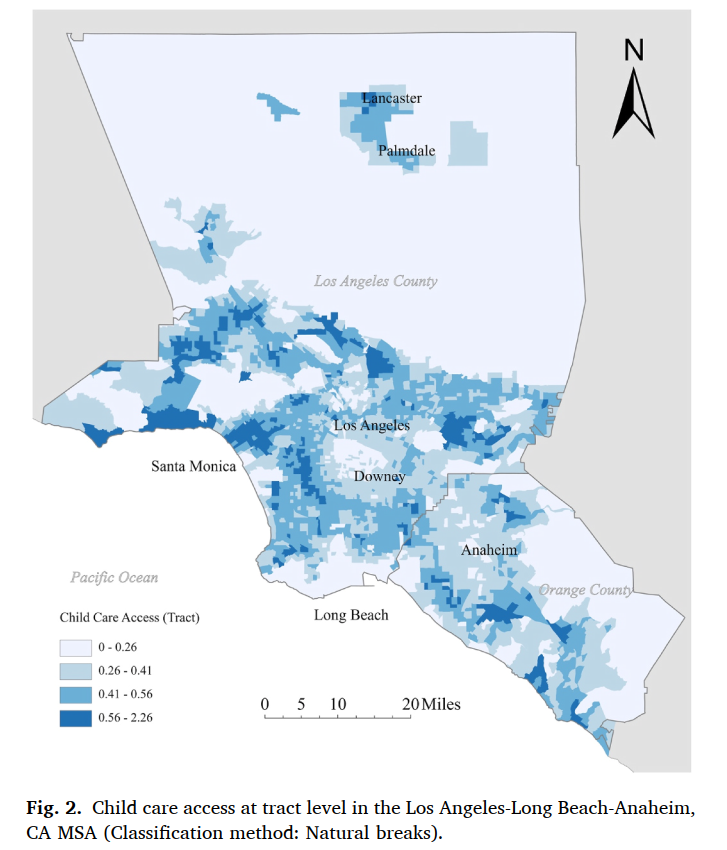
Map of child care access across the Los Angeles metropolitan area
2023Child care geography

Variation in child care access across neighborhood types

Topic
Whether the supply of formal child care keeps pace with demand across different kinds of California neighborhoods.
Method
A two-step floating catchment area model combines licensed capacity, young-child population, travel time, and neighborhood typologies; regression tests geographic and demographic differences.
Implication
Newly developed suburbs—and many Latinx and rural communities—face lower access. Provider incentives and family support should be geographically targeted.
Read the paper
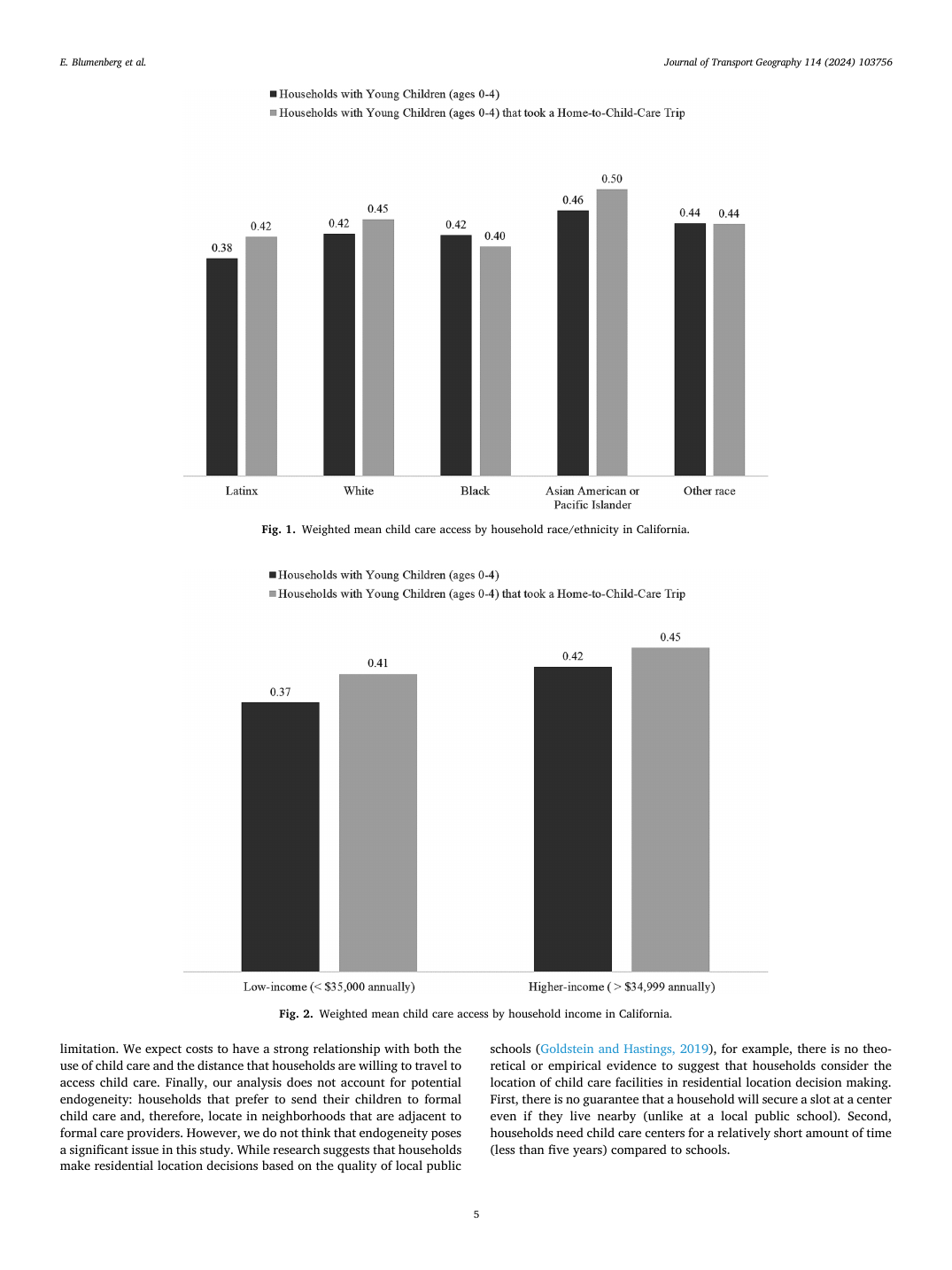
Charts comparing child care access by household race, ethnicity, and income
2024Access & travel

Decisions & distance: Child care access and child care travel

Topic
Whether greater formal child care access changes families’ use of care and the distance they travel from home.
Method
A travel-time-weighted 2SFCA measure is linked to California household travel data; multivariate models predict formal-care use and home-to-care distance.
Implication
Better access makes formal care more likely and trips shorter. Child care investment, transportation assistance, and better care-travel data can reduce spatial barriers.
Read the paper
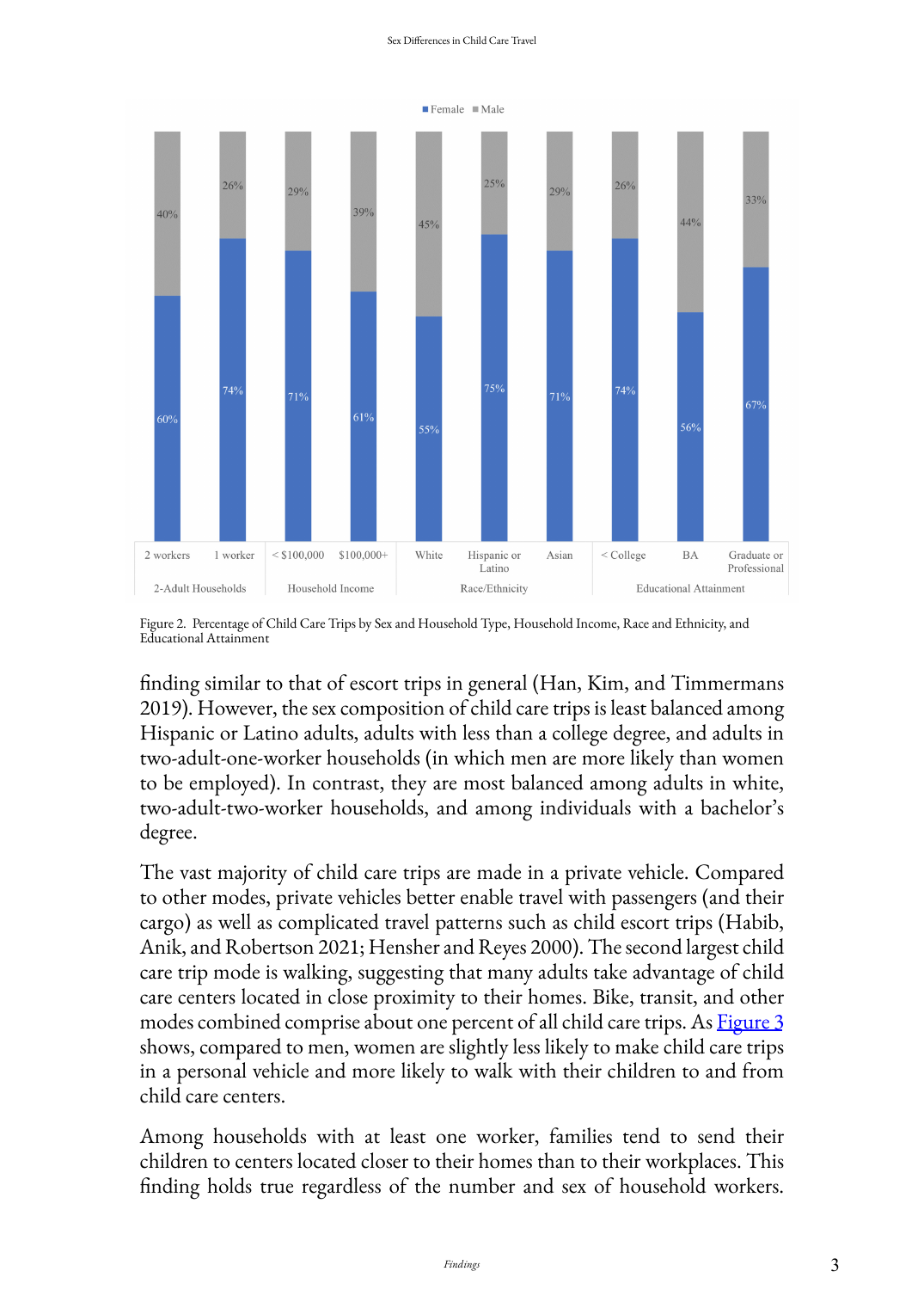
Chart showing the percentage of child care trips made by women and men across household groups
2024Gender & mobility

Sex differences in child care travel

Topic
How responsibility for child care travel differs by sex—and how that shapes travel mode and distance relative to home and work.
Method
California NHTS travel diaries are spatially matched to licensed child care facilities, then analyzed with demographic and socioeconomic controls.
Implication
Women make more than 70% of child care trips and are more likely to walk. Transportation analysis should explicitly account for care trips, proximity, and gendered household responsibilities.
Read the paper
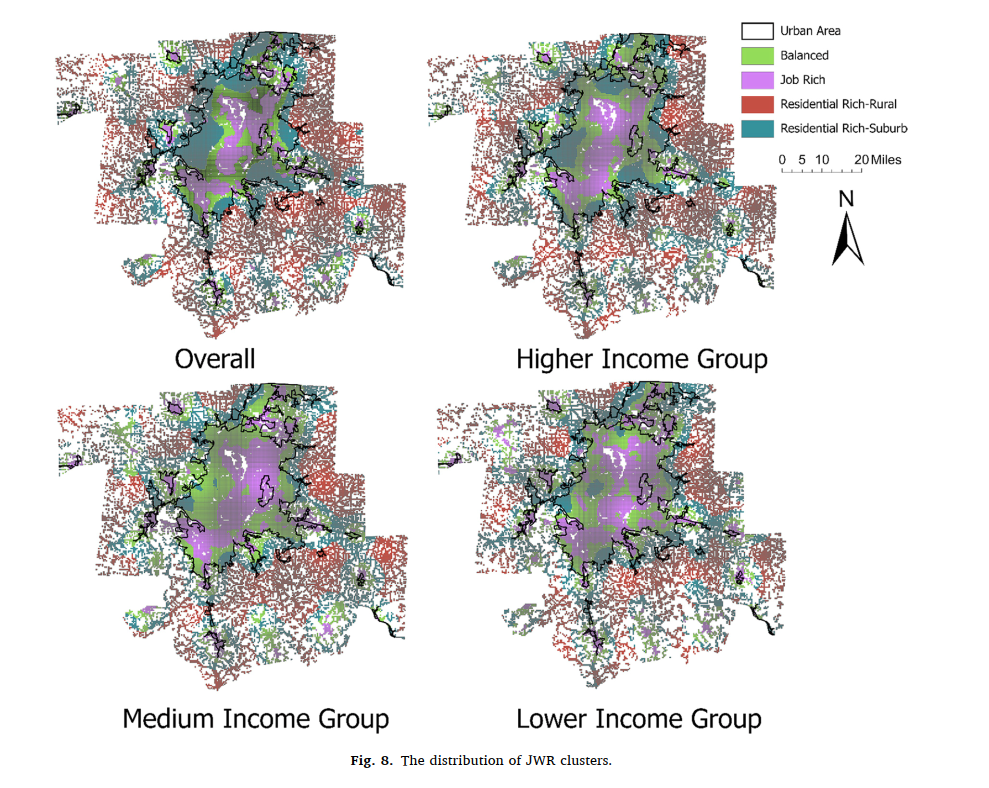
Maps of jobs-housing clusters in Cincinnati for overall and different income groups
2022Jobs & housing

Multiscale jobs-housing balance and employment self-containment

Topic
How jobs-housing balance and the ability to work near home vary by spatial scale and worker income.
Method
2016 LEHD data, Monte Carlo simulation, multiscale buffers, and K-medoids clustering identify matched and mismatched patterns across Cincinnati.
Implication
There is no single “correct” scale for measuring balance, and income groups respond differently. Land-use and transport policy should target specific mismatches rather than rely on one regional ratio.
Read the paper
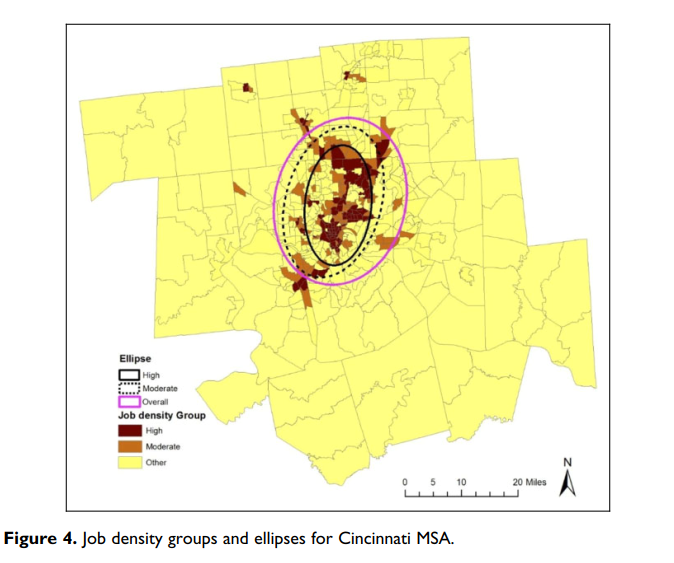
Map showing job-density groups and spatial ellipses for the Cincinnati metropolitan area
2019Urban structure

The changes of urban structure and commuting

Topic
How metropolitan employment decentralization changed from 2000 to 2010 and how different forms of decentralization relate to commuting.
Method
Standard-deviation ellipses and two urban-structure indices compare job-density nodes with residential workers across large U.S. metropolitan areas; regression links structure to travel time by mode.
Implication
Decentralized high-density job nodes can shorten car commutes, while dispersed moderate-density employment can lengthen travel. The form of decentralization matters more than decentralization alone.
Read the paper
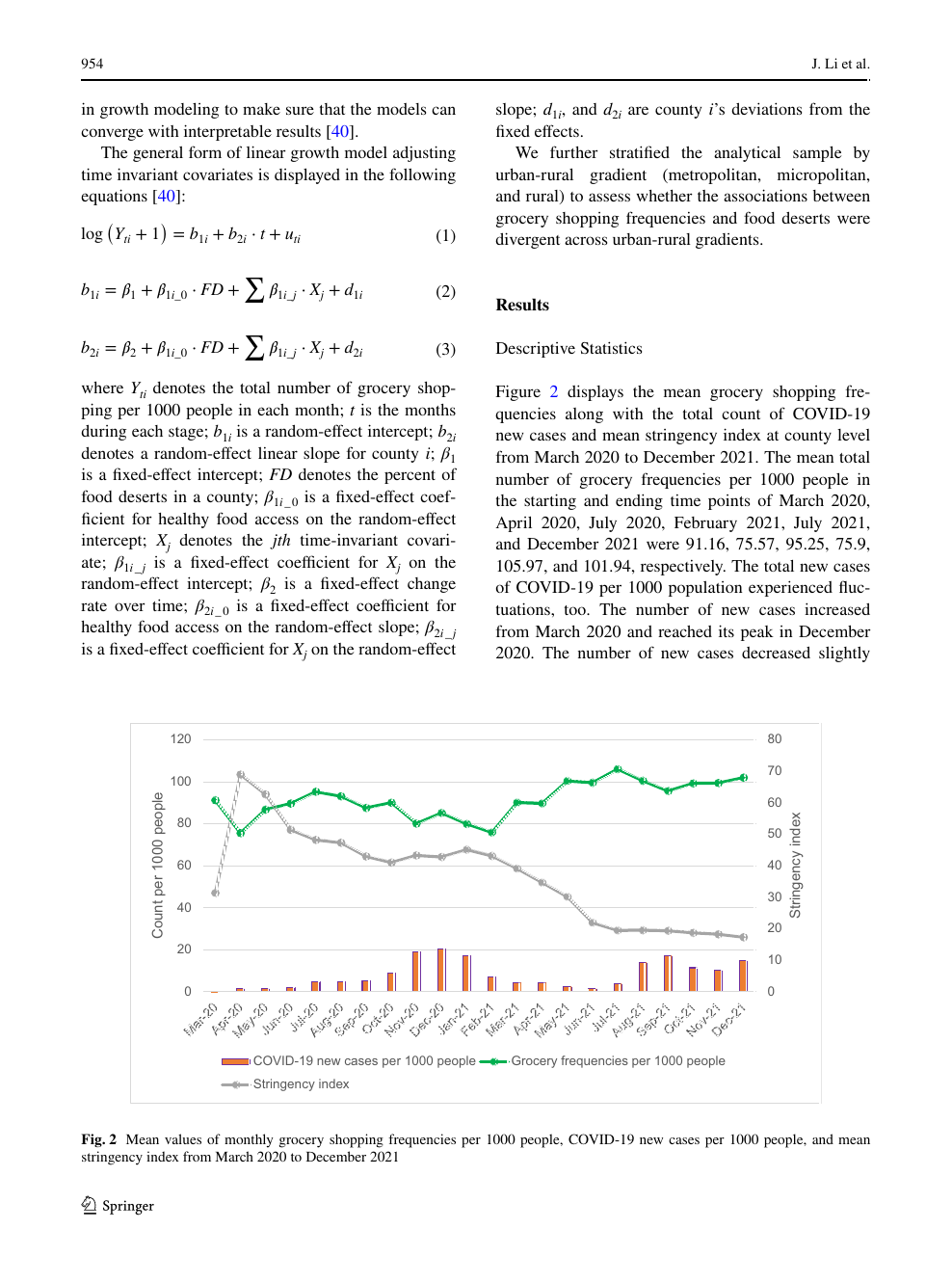
Chart showing monthly grocery shopping frequency, COVID-19 cases, and policy stringency from 2020 to 2021
2023Food access

Grocery shopping, food deserts, and the COVID-19 pandemic

Topic
How grocery-shopping frequency changed through the pandemic and whether recovery differed by food access and rurality.
Method
Monthly SafeGraph visits to 70,326 grocery stores in 2,984 U.S. counties are modeled across five pandemic stages using growth curves and urban-rural stratification.
Implication
Shopping followed a W-shaped trajectory, but counties with more food deserts—especially rural counties—were more vulnerable. Emergency planning must protect safe, reliable food access where options are already scarce.
Read the paper
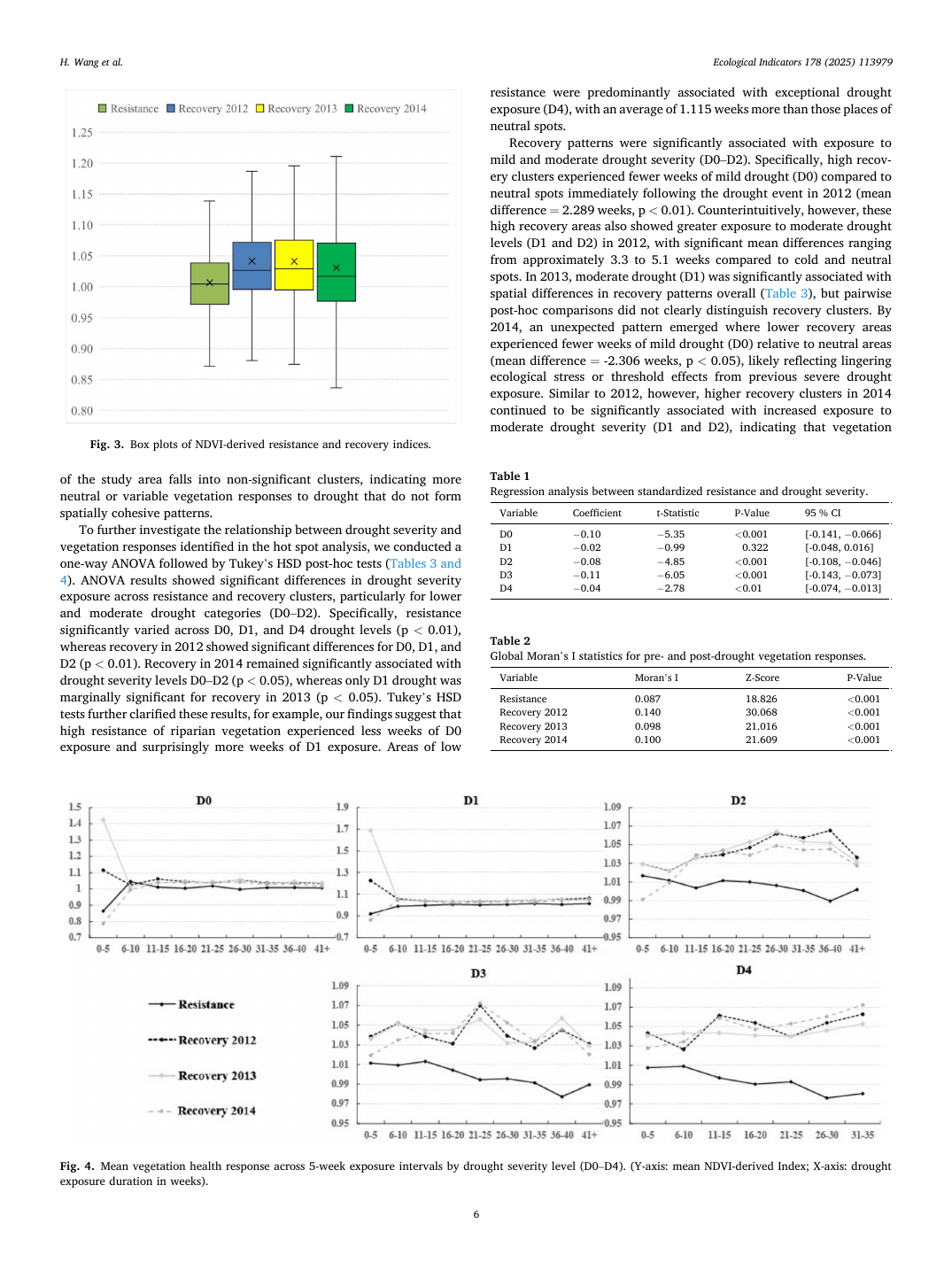
Charts comparing riparian vegetation resistance and recovery across drought severity levels
2025Environmental resilience

Riparian vegetation health and drought severity

Topic
How riparian vegetation in the Lower Mississippi River Basin resists and recovers from drought of different severity.
Method
U.S. Drought Monitor classes are integrated with MODIS NDVI; regression, Moran’s I, hot-spot analysis, and ANOVA trace resistance and recovery from 2010–2014.
Implication
Drought severity alone does not explain vegetation response. Land management, drought history, and spatial context are essential for interpreting resilience and targeting ecosystem management.
Read the paper

Selected publications

Research in print.

2025

Evaluating public transportation through a caregivers’ lens

C. Quattro & Z. Yao · Cities & Health

PDF ↗
2024

Sex differences in child care travel

Z. Yao, E. Blumenberg & M. Wander · Transport Findings

PDF ↗
2024

Decisions & distance: Child care access and child care travel

E. Blumenberg, M. Wander & Z. Yao · Journal of Transport Geography

PDF ↗
2025

Unraveling the link between riparian vegetation health and drought severity

H. Wang, Z. Wang, S. Qu, X. Que & Z. Yao · Ecological Indicators

PDF ↗
2023

Variation in child care access across neighborhood types

E. Blumenberg, Z. Yao & M. Wander · Applied Geography

PDF ↗
2023

Grocery shopping frequencies and food deserts during COVID-19

J. Li, C. Kim, D. Cuadros, Z. Yao & P. Jia · Journal of Urban Health

PDF ↗
2022

Multiscale patterns of jobs-housing balance and employment self-containment

Z. Yao & C. Kim · Computers, Environment and Urban Systems

PDF ↗
2019

The changes of urban structure and commuting

Z. Yao & C. Kim · International Regional Science Review

PDF ↗

Teaching

Spatial thinking,
made practical.

I teach students to move confidently between geographic questions, computational methods, and responsible interpretation.

GHY 5530Transportation GIS
GHY 4812 / 5812GIS Analysis & Modeling
GHY 5815GIS Programming & Database
GHY 5800Advanced Quantitative Analysis

Also a certified Carpentries instructor, teaching reproducible research with Python, R, and QGIS.

About

Zhiyuan Yao, Ph.D.

I am an Assistant Professor in the Department of Geography and Planning at Appalachian State University. Before joining App State, I worked at UCLA’s Institute of Transportation Studies and Data Science Center. I earned my Ph.D. in Geographic Information Sciences from the University of Cincinnati.

My research sits at the intersection of geospatial data science, transportation, accessibility, and urban systems—with growing emphasis on the resilience and equity challenges facing rural communities.